
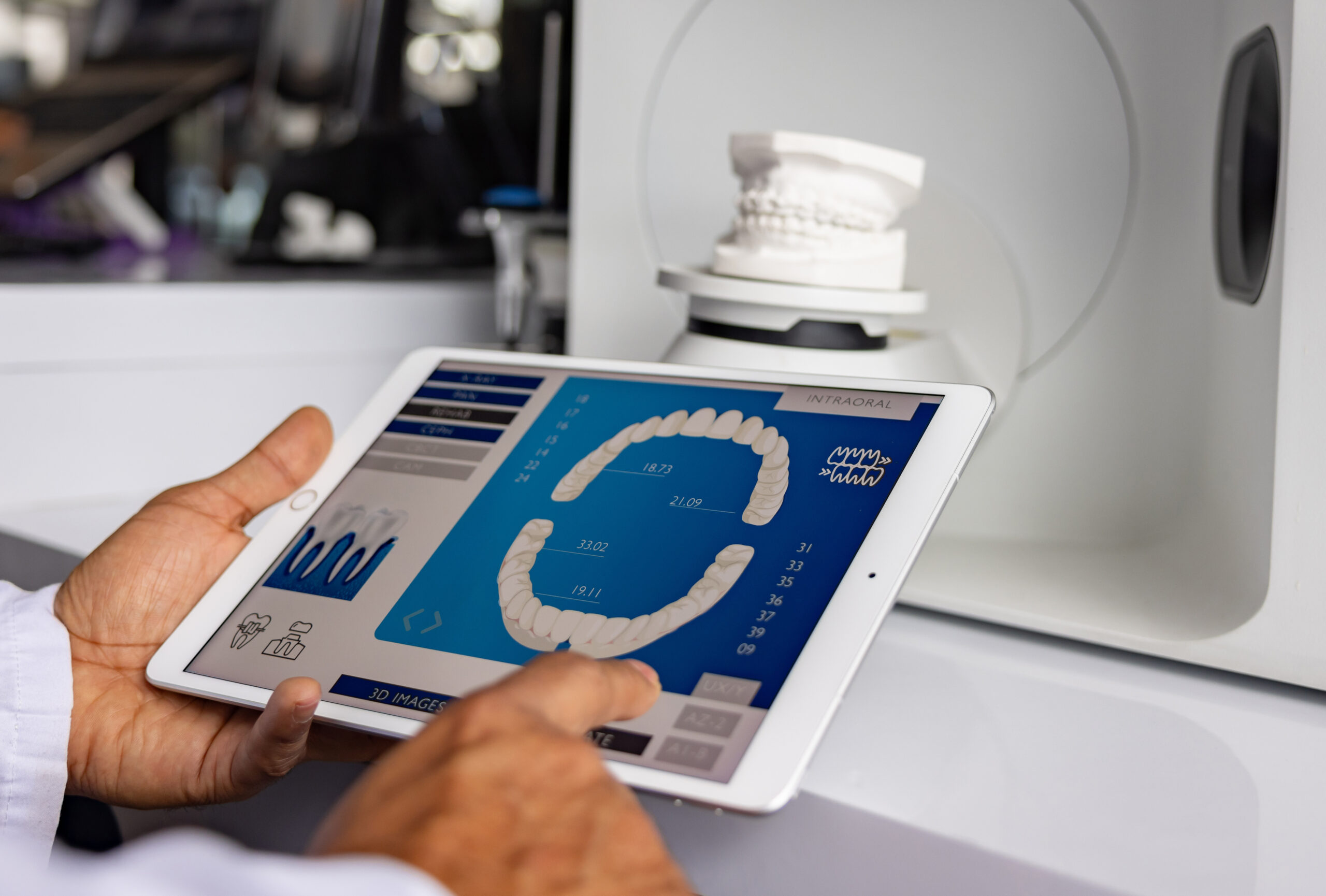
Dentistry has changed dramatically, raising the standard of patient care. Digital dentistry is no longer a future concept but an established reality used every day in clinical practice.
This field combines advanced technology and AI to replace analogue techniques with digital workflows that offer millimetre-level precision. For patients, that means no more uncomfortable paste impressions. Intraoral scanners create an accurate virtual model of the mouth instead. For us, it supports a more conservative, safer and minimally invasive approach to dentistry, making treatment less stressful overall.
It is currently used routinely in the following treatments:
Clear aligners: planning built on predictability
The use of AI has turned the design of clear aligners into a predictable process. The system analyses 3D scans to simulate tooth movement before treatment begins. This makes it possible to visualise the final result on screen, optimising both aesthetics and effectiveness, and ensuring that patients know what to expect from their new smile.
Smile design and veneers
Digital design makes it possible to overlay facial photographs of the patient with a three-dimensional scan of the mouth. This gives the clinician real-time feedback on how the new teeth harmonise with the features of each face.
FirstFit technology stands out as the only fully computer-guided system for preparing and cementing veneers. Its main advantage is efficiency. While the traditional method usually requires several trips to the dentist, FirstFit is completed in a single 90-minute appointment. Using 3D-printed guides with micron-level precision, it is minimally invasive, preserves natural enamel more effectively and eliminates the need for temporary teeth.
Guided surgery for dental implants
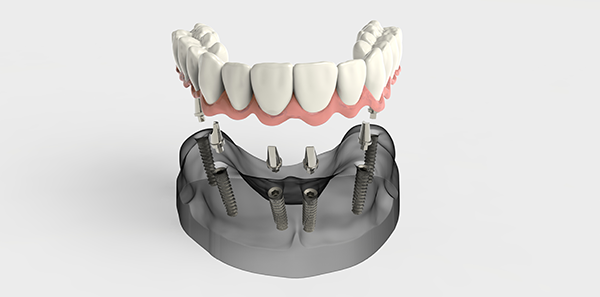
Guided surgery has taken implant treatment safety to a very high level. By combining 3D tomography (high-precision X-rays) with intraoral scanning, it creates a complete virtual model of the patient. This allows the surgeon to plan the precise implant position based on both the available bone and the future crown, using custom guides to reduce risk. In many cases, implants can even be placed without open surgery, which supports a faster postoperative recovery.
AI applied to diagnostic imaging
AI acts as a second pair of eyes, analysing X-rays up to 79 times faster than the human eye and detecting up to 37% more abnormalities that could be missed in a conventional examination.
The dentistry of the future: a present-day reality
Digital technology is already part of our daily clinical practice, improving precision and helping us deliver care that is both more accurate and more personal. By combining different types of images into a single digital view, we can offer each patient safer, more tailored treatment that meets the standards of modern dentistry.
Dr Beatriz Galindo
Dentist at Beatriz Galindo Dental Clinic